Destroyer of Heresies


"Meanwhile, Venerable Brethren, fully confident in your zeal and work, we beseech for you with our whole heart and soul the abundance of heavenly light, so that in the midst of this great perturbation of men's minds from the insidious invasions of error from every side, you may see clearly what you ought to do and may perform the task with all your strength and courage. May Jesus Christ, the author and finisher of our faith, be with you by His power; and may the Immaculate Virgin, the destroyer of all heresies, be with you by her prayers and aid."
Pope St. Pius X, Pascendi Dominici Gregis

Saturday, September 9, 2017

Great Principle or Human Folly?

Pope Francis promulgated an Apostolic Letter motu proprio (of his own initiative) on September 3rd, 2017, in which he revises a clause in Canon Law to more clearly delineate the powers to determine liturgical legislation and norms between the Pope and the episcopal conferences. Paragraph one reads

The great principle, established by the Second Vatican Ecumenical Council, according to which liturgical prayer be accommodated to the comprehension of the people so that it might be understood, required the weighty task of introducing the vernacular language into the liturgy and of preparing and approving the versions of the liturgical books, a charge that was entrusted to the Bishops.

But is it truly a "great principle" (magnum principium)? Is this principle based on truth or speculative theories?
My analysis:
Fr. Josef Jungmann's Corruption Theory is a fruit the Ressourcement movement and thinking. Jungmann's theory that the primitive liturgy was corrupted between the Constantinian and Baroque periods is dependent on upon certain historical conclusions that are not settled. In addition to his Corruption Theory his Pastoral Liturgy Theory also presupposes the Ressourcement ethic of anthropocentric liturgy centered in the EXPERIENCES OF THE FAITHFUL. This reliance on experience is condemned by St. Pius X in Pascendi gregis #7 and #14. His system also relies heavily upon modern philosophy (after all, he's a Jesuit) and a pseudo-historicism that is rejected in #30 of the same encyclical.
Fr. Jungmann is certainly an important voice in the Liturgical Movement and a luminary in contemporary liturgical scholarship. But his personal conclusions are not something Catholics are required to accept and much less rely upon as though this is the only cogent explanation for liturgical development.
The overestimation of a pristine liturgical norm that was lost after the Edict of Milan and was only meaningfully recovered with Paul VI's fabricated liturgy is based on the Documentary Hypothesis which since its peak in popular acceptance in the 1970s has been in steady decline since.
Jungmann's theories are dependent upon an ahistorical or even antihistorical understanding of liturgy and the role of the Popes in preserving it.
Lastly, the experiment in liturgy begun in 1963 after the signing of Sacrosanctum concillium has yielded none of the results promised by its theorists, chief among whom were Fr. Jungmann, Dom Beauduin, and of course Annibale Bugnini. In fact Cardinal Ratzinger concludes the Roman liturgy has collapsed:
"I am convinced that the ecclesial crisis in which we find ourselves today depends in great part upon the collapse of the liturgy, which at times is actually being conceived of etsi Deus non daretur: as though in the liturgy it did not matter any more whether God exists and whether He speaks to us and listens to us.
...But if in the liturgy the communion of faith no longer appears, nor the universal unity of the Church and of her history, nor the mystery of the living Christ, where is it that the Church still appears in her spiritual substance?"
And is it true that that these reforms were undertaken because the Catholic faithful did not understand the mystery of the holy sacrifice of the Mass because it was in Latin? In 1960, 75% of American Catholics attended Mass at least weekly. Today that figure hovers around 25%. Of that 25%, almost none are aware that the Mass is a propitiatory sacrifice the Son offers to the Father as the Divine Victim immolated in an unbloody manner on the altar at the hands of the sacerdotal priest in persona Christi. So what has this great reform-to-improve-comprehension actually produced?  And why would the Pope want to double down on such a dismal failure, if not for ideological reasons?

As far as the vernacular, the dogmatic Council of Trent (1545-1563) infallibly condemned liturgy in the vernacular only (Session 22, Canon IX). So what is really going on here? And what will the further balkanization of the Catholic Church do to its universality in creed and prayer?
"The vulgar languages are in continual change; often words do not have today the same meaning that they had yesterday, or at best have one meaning for one person and another for someone else. About these terms we can truly say with Sallust, "Vera vocabula rerum amisimus" (Catil., c. 52). We have lost the right words in these cases. However, the Latin language is not only the most organic and logical language that has ever existed, but, for the very fact that it is no longer spoken by the people, it is now fixed, precise, and unequivocal, and presents us with well defined technical terms which have already been consecrated by the Church as the fruit of long discussions and solemn definitions, terms which it would be dangerous to ignore."
- The Memoirs of Antonio Cardinal Bacci

Friday, July 21, 2017

The Slow Death of the Novus Ordo in the West

As the numbers of vocations continue to dwindle in the West, where priests are recruited from Nigeria, Ghana, Cameroon, India, Vietnam, and the Philippines, the entire experiment of anthropocentric religion in Catholic guise is on the verge of collapse.

The new religion of man focused on this present world and getting along with everyone is failing in spectacular fashion. Looking at just the demographics of priests, the collapse will come absolutely unforced, by the mere power of math and statistics. The average age of a Catholic priest in the United States in 1970 was 35. These men would have begun their priestly formation well before the Second Vatican Council (1962-1965) when vocations were abundantly plentiful under Pastor Angelicus, Pope Pius XII. Today, the average age of a Catholic priest in the USA is 64. The demographics of Catholics themselves are also cascading downward in a breathtaking manner: birthrates in Europe, Canada, the US and even South America have fallen below the replacement rate.

CBS News Report: Catholic Church feels squeeze of priest shortage

Quite apart from any malicious strategy applied by the Church's enemies from without, the collapse of the Western Church appears to be an inside job. The elevation by Pope John XXIII of theologians suppressed under Pope Pius XII is where the enemies of the true faith were able to come out in the light of day. Pope Angelo Roncalli not only rehabilitated the neoModernist theologians, he tied the hands of every orthodox prelate by announcing that Vatican II (and the orientation it introduced) would condemn no errors (the "medicine of mercy" hermeneutic). So at once we had a condemned theology and no mechanism whereby to oppose it.

Paul VI went further by reforming the Holy Office into the Confraternity of the Doctrine of the Faith, abrogating the Oath Against Modernism, and dissolving the Index of Forbidden Books. His most grievous damage of course was done by suppressing the Missal of St. Pius V and promulgating Fr. Annibale Bugnini's man-made Forma Normativa as the Novus Ordo Missae. Pope John Paul II reformed the code of Canon Law in 1983 which included the abrogation of 141 canons dealing with the beatification and canonization process, dissolving the function of "devil's advocate" in the office of the Promotor Fidei. This effectively denuded any attempts to investigate the worthiness of candidates for Sainthood, and in just 25 years John Paul II beatified one-third of all the Blesseds in Church history.

The practice of making it nearly impossible to condemn any errors or apply any canonical standards to contemporary teaching was made even more self-destructive for Catholics by urging the twin-headed spectacle of pan-christian ecumenism and inter-religious dialogue. Stripped of all means of determining truth and error and sent blindly into endless 'dialogue' with the practitioners of all religions produced a predictable result. What once was the only way to obtain eternal salvation eroded into just one of many ways of praying, believing, of seeing man and the world.

According to Pope Benedict XVI however, the real cause of the crisis in the Catholic Church is the collapse of the sacred liturgy, and in particular, the Mass. The form of the Mass handed down from the earliest Christian centuries and attributed to the Apostles was universally suppressed in 1970, giving the faithful the idea that it was somehow now no longer needed, ineffective, or even worse, something evil that should be shunned and avoided. While indults were permitted for the Tridentine Mass between 1984 and 2006, few Bishops allowed it. By the time Pope Benedict XVI liberated it from the control of hostile prelates in 2007, it had been suppressed for 37 years, effectively wiping out all memory of centuries of liturgical Tradition. To add to the stigma, Pope Paul VI and John Paul II unjustly censored the most fruitful missionary bishop of the 20th century for the 'crime' of forming priests for the Traditional liturgy.

Now its all about the demographics. An aging priesthood offering only the man-made Mass of Paul VI on behalf of an aging population of Catholics who contracepted and aborted themselves into fewer and smaller families has amply demonstrated the folly and hubris of the Second Vatican Council's reformers. The experiment of anthropocentric religion has failed, and the price of adopting its theories and reforming the Church thereby is the collapse of Catholicism in the West. Soon there will simply be almost no priests left to baptize, absolve, and confect the Eucharist.

All is not lost. Those who rebuilt the edifice of Catholic Tradition while covered by the shadow of stigma as "schismatics" and "excommunicates" are enjoying a profound resurgence of health and vitality. The seminaries that form priests for the Traditional Latin Mass are bursting at the seams with new vocations. Again, simply by the math, at some point in the not-too-distant future, they will overtake the aging, graying, and rapidly diminishing Vatican II priests and become the majority. If Christ does not return in the next two or three decades, the conciliar priests will simply die off, fade away into history, and be remembered as those who drove a healthy, vibrant Catholic Church into near-irreversible decline only to be rescued by the very priests they ostracized, marginalized, and oppressed. And with these young priests practicing Tradition come the young families with lots of Catholic babies.


There is a divine lesson to be learned here for those who have eyes to see, ears to hear, and can master elementary math.

Saturday, May 27, 2017

SodoModernism and the crisis in the Church


I don’t intend to write a long article here, but I wish to define a coalition among the enemies of the Church who operate from within her to destroy the foundations of Catholic dogma. These are the theological Modernists and the Sodomitical clerics.  The Modernists rejected Scholastic theology in favor of modern philosophy. The partisans of Modernism see the world in perpetual evolution, the faith in perpetual development, and the essence of ‘being’ as the essence of ‘becoming.’ In this world view, the Scriptures are merely products of their epochs, as are the ecumenical councils and the landmark Papal encyclicals. Man must find religion within himself, and this religion is within all men via the evolutionary processes.

The sodomite clergy, boasting an unknown but substantial percentage among the ordained, have entered the priesthood under false pretenses. Their ordinaries are culpable for their infiltration into the Church’s hierarchy. These men are incapable in most cases of holding the Catholic Faith at all, much less to function in persona Christi as pastors and spiritual fathers. Yet the Modernists have allied themselves with the sodomites in a conspiracy of convenience: both are bent on promoting change within the Church.

The Modernists follow their prophet Teilhard de Chardin, whose grotesque subjugation of Catholic religion to Evolutionism leads to a convergence of all religions into a supra-religion, a melding of consciousness that culminates at a fictional ‘Point Omega.’ The sodomitical priests are desperate to have their perversion not only tolerated but accepted in the Church as a legitimate ‘development of doctrine.’ This requires revolutionary change in faith and morals. In a mutually supporting alliance, these two factions have joined forces to effect a revolution within the Catholic Church over the past 50 years.
Catholic priests add their blessing to pro-homosexual efforts within the Church.

To the Modernists, everything must be new: Pope John XXIII declared a New Pentecost was underway. Pope Paul VI hailed a New Advent. Pope John Paul II inaugurated a New Evangelisation that was to effect the fruition of a [mythical] New Springtime in the Church. The sodomites, seizing the occasion of so much novelty in the Church, the crowning innovation being the Missal of Pope Paul VI, went to work at promoting everything that seemed associated with “change” and “reform” in the Church.

Pope John Paul II made it the supreme cause of his pontificate to advance the reforms of Vatican II, which in his own words culminated at the Prayer Meeting of All Religions for Peace at Assisi in 1986. No wonder then that the priesthood filled up with abusers and sodomites during his reign. It may be said without exaggeration that the ‘gay’ clergy were secretly some of his most zealous supporters when it came to advancing all the change within the Church.

And so we have a foundation-shaking crisis within the Church: her bedrock dogmas and doctrines are assailed from within by Modernism, and the apostles of this false Catholicism are priests: those who are committing the sin against nature, those are disposed towards it; and those that who are sympathetic to them.

We pray and work then for a champion who will reject the New Theology and the corrupted priesthood. We pray and work for a recovery of soundness, stability, and a real continuity with the perennial magisterium of the Catholic Church. We hate no one; we eschew all revolution and sophistry, and live our lives as devoutly as we can with the assistance of God’s bountiful graces, which He distributes as He wills.

But we also take up the arms of prayer and theology to combat these toxic errors and these false apostles in the Church. The preaching of our Lord’s holy cross must be at the center of our efforts of restoration.  The preaching of Christ crucified, the divine kerygma, is hated by the SodoModernists. Yet it is the way souls are freed from bondage to sin and error. May the Holy Ghost impart to each of us the light to see not only the crisis but the arms He provides to combat it. And may we persevere out of obedience to God and love for poor sinners. The way back will certainly be long and arduous; but no way ‘forward’ is possible without continuity with the work our Triune God has already established and blessed throughout the centuries. SodoModernism is doomed to fail, but we must do our part to fight against it.

Friday, April 21, 2017

Source of Modern Theological Errors


If you look at St. Pius X's encyclical Pascendi Dominici gregis paragraphs 44-55 you will see a very specific, detailed, comprehensive plan to root out Modernism from all Catholic institutions and societies. These policies were more or less sustained under Benedict XV and to a lesser extent under Pius XI. When Cardinal Eugenio Pacelli was elected Pope in 1939, he returned to the program introduced by St. Pius X but much had transpired between 1914 and 1939.

The interwar years were the period where the Modernists developed their underground networks and clandestine publishing enterprise. This is the primary way spirits like Teilhard de Chardin were countenanced, because under Pius XII he was forbidden to publish and teach. Pacelli was also very vigilant against the Nouvelle Theologie and the Ressourcement movements and with Cardinal Ottaviani as the Prefect for the Holy Office, suppressed the works of conciliar luminaries such as Henri de Lubac, Hans Urs Von Balthasar, Karl Rahner, and even Josef Ratzinger who was suspected of heresy.

We see these errors confronted in 1950 with the sky-splitting encyclical Humani generis featuring the subtitle, CONCERNING SOME FALSE OPINIONS THREATENING TO UNDERMINE THE FOUNDATIONS OF CATHOLIC DOCTRINE. Sound familiar? It should. It deals directly with the same level of threats treated in St. Pius X's Pascendi.

It is often portrayed as having a decisive influence from Fr. Reginald Garrigou Lagrange who, in his essay "Where is the New Theology Leading Us?" answered with "back to Modernism." The recommendations to combat the "false opinions" given in paragraphs 18-21 and 41-43 are nearly the same ones provided by Pius X: return to Scholastic philosophy and depart not from it.

Fr. Reginald Garrigou-LaGrange, O.P.
This is the battlefront of the theological war that ensued: modern philosophy vs. Scholastic philosophy. Those in favor of the former based their reliance on modern philosophy on a felt need to harmonize theology with the 'new science' epoch that began with Copernicus and peaked with Teilhard - both Catholic priests, mind you. The New Theology partisans argued that the mythical creature known as 'modern man' would not accept 'ready made truths' fed by the manualists to reluctant theology students. St. Pius X and Pius XII knew what letting go of St. Thomas would mean in the environment of the utopianism of the 19th and 20th centuries: a wholesale plunge into novel theories without being moored in Tradition. And those apprehensions have been confirmed 1,000 fold.

This insistence on the primacy of science dealt a staggering blow to belief in the supernatural. The men of science stigmatized miracles as 'myths' and 'magic' and sought to save the 'stories' of the Bible by divining "what the sacred writer meant to say" - a system expressly condemned by Pope Leo XIII in Providentissimus Deus. Yet this view was widely seen as 'relevant' and more in tune with ways of 'modern man', so much so that Vatican II stated,
"May the faithful, therefore, live in very close union with the other men of their time and may they strive to understand perfectly their way of thinking and judging, as expressed in their culture. Let them blend new sciences and theories and the understanding of the most recent discoveries with Christian morality and the teaching of Christian doctrine, so that their religious culture and morality may keep pace with scientific knowledge and with the constantly progressing technology." (GS #62) 
May keep pace! So that religion may keep pace with science!

Loss of belief in the supernatural order always results in a loss of divine and Catholic faith.

John Paul II devoted his life to an impossible task: synthesizing Thomism and Personalism/Phenomenology. This of course is a violation of the law of noncontradiction. The existentialist-subjectivist philosophies can never be synthesized with Scholastic philosophy because they are polar opposites with two diametrically opposed versions of reality. Scholasticism begins with God and ends with man. Existentialism begins with man and ends with whatever each man determines is real. JPII approached the mystery of the Incarnation with a personalist paradigm and concluded that by it Christ has united Himself forever with each man. Thus, each man by accepting his 'transcendent' humanity accepts the Christ with whom he is united, even if he is utterly ignorant of this Christ.

He inverted the mystery of the incarnation by establishing a novel theory from Vatican II's Gaudium et spes known as the 'mystery of man'. This mystery concludes that Christ by revealing the Father and His love to man also reveals man to man himself. Giuseppe Cardinal Siri concluded that this means either Christ is a mere man or each man is divine (Gethsemane). In this theory, Christ reveals man's supreme dignity to him: not in potency, viz, if a man accepts the Son, he receives the power to become a son of God (St. John 1:11); but in actuality, viz, each man is already a "sharer in Jesus Christ" and a "partaker of the mystery of redemption" (RH).

The greatest error produced by this anthropocentric inversion is that the Incarnation is identified as the cause of the Redemption of mankind. The Church has always taught that the PASSION of Christ was the cause of redemption - His death, burial, and resurrection - this priestly sacrifice is what redeems man. John Paul II reduces the cross to the "sign of God's love for man" and the proof of man's surpassing dignity. He makes the Incarnation the cause of redemption. Check Redemptor hominis carefully; he mentions redemption 37 times; the word justification - that process by which the redemption is subjectively applied by faith and baptism - is never mentioned. Neither will one find the word "Catholic" anywhere in the encyclical.

To sum it all up, we must look to what is considered as Pope John Paul II’s greatest dogmatic achievement: the promulgation of the Catechism of the Catholic Church in 1992. This volume quotes Vatican II over 600 times. It quotes John Paul II 135 times. It never quotes St. Pius X - not even once - who led the Church in its combat against the most dangerous collection of errors ever to menace her - Modernism - just 80 years prior.

At the time (1992) Pius X was the last canonized Pope. Before him, it was Pius V. How one can leave St. Pius X completely out of any 20th century catechism staggers the imagination - unless it is a deliberate conspiracy of silence to avoid the confrontation Papa Sarto is yet making with the Synthesis of all Heresies even today. Think about it.

Saturday, November 12, 2016

The New Theology: true pastorality requires a new understanding of doctrine

"Pope John [XXIII] and Vatican II initiated a profound shift in how one perceives doctrinal authority..." (15:30ff)

  - Dr. Richard Gaillardetz, Oblate School of Theology for the Second Annual Louis Vance Chair of Systematic Theology Lecture. 

This must be unpacked.

First of all because Pope John elevated the very theologians (and by extension their condemned theses) that were suppressed under Pope Pius XII. These men (Balthasar, Congar, Rahner, de Lubac, Chenu, Ratzinger, etc...) advanced what Fr. Garrigou LaGrange called "Nouvelle Theologie" or a new theology which he concluded led us right back to Modernism, the synthesis of all heresies. Secondly, Pope John in the opening address of Vatican II deliberately set aside all condemnations of error for the life of the council - and this certainly represents a fundamental shift in the 'perception of doctrinal authority...' Which left us with the double whammy of rehabilitating condemned theology and the inability to condemn any errors. What else could this bring but revolution in the "pastorality" (the professor's word) of the Catholic Church?

     Scholastic theology was set aside with its emphasis on reality, immutable essences, and concrete manifestations of the divine Being and in its place emerged personalism, phenomenology, and existentialism - all condemned in Pius XII's Humani generis. Thus, experience was elevated above objective truth - including both natural and supernatural theology - in order to reach mythical 'Modern Man' in ways the neoModernists felt were palatable to him. St. Pius X on the danger of building doctrine upon human experience:
"How far off we are here from Catholic teaching we have already seen in the decree of the [first] Vatican Council. We shall see later how, with such theories, added to the other errors already mentioned, the way is opened wide for atheism. Here it is well to note at once that, given this doctrine of experience united with the other doctrine of symbolism, every religion, even that of paganism, must be held to be true. What is to prevent such experiences from being met within every religion? In fact that they are to be found is asserted by not a few. And with what right will Modernists deny the truth of an experience affirmed by a follower of Islam? With what right can they claim true experiences for Catholics alone? Indeed Modernists do not deny but actually admit, some confusedly, others in the most open manner, that all religions are true. That they cannot feel otherwise is clear. For on what ground, according to their theories, could falsity be predicated of any religion whatsoever?"
ON THE DOCTRINES OF THE MODERNISTS 

Truly pastoral as opposed to what?
Pius XII? Was his magisterium not 'truly pastoral'?
Does this excitable academic not know that Pope Pacelli's colloquial title was Pastor Angelicus? The angelic pastor? 
These guys never come out and say what their theories all purport: the Church under Pius XII was in grave error in praxis if not in doctrine, and the conciliar Pontiffs have corrected centuries of these errors. The facts of history however point to a completely opposite conclusion: the Church was in robust health under Pius XII and has been declining precipitously ever since.

Sunday, January 17, 2016

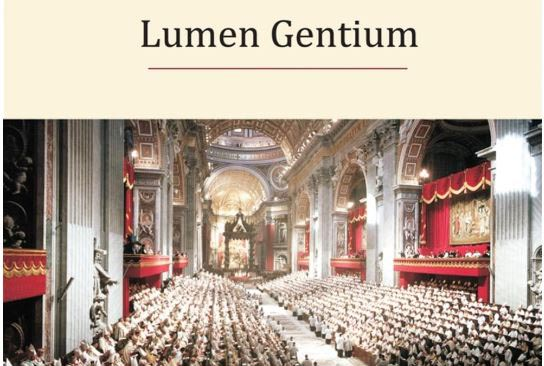
The New Ecclesiology of Lumen Gentium

There is no escaping several novelties in Lumen gentium (LG), among which are the church as 'sacrament' (yes, we know the Latin is = to 'mystery'); the introduction of the concept of the unity of mankind (not specified as in Adam, a unity of mere nature); the Church as "the Church of Christ which subsists in the Catholic Church"; the unbalanced and overly optimistic view of the non-Christian religions; the amorphous title "People of God" which many have conflated with all mankind per LG 1,1); and lastly, the Council's ethic of not condemning any errors at all, providing no canons or anathemas, which leaves all these ambiguities open to various interpretations.

We cannot minimize the figure of Fr. Karl Rahner, S.J. in the drafting of this document, either. Knowing that he was an evolutionist, and an existentialist, and a proponent of the "anonymous Christian" theory, we must look for the Rahnerian signature if not always in the texts, then in the possible ways of exegeting it. For Rahner, the distinction between nature and the supernatural is muted if not dissolved. He also sees a radical unity between matter and spirit a la Teilhard de Chardin. This leads to his heterodox theory of the supernatural existential - that all men have divinity at their radical center. Seeing Rahner's theology and thoroughly novel metaphysics signature helps us to understand why LG has destroyed so much of orthodox ecclesiology today.

Finally, taking the above into consideration, we must see how Pope John Paul II interpreted Vatican II in his encyclical Redemptor hominis which claims,
"Entrusting myself fully to the Spirit of truth, therefore, I am entering into the rich inheritance of the recent pontificates. This inheritance has struck deep roots in the awareness of the Church in an utterly new way, quite unknown previously, thanks to the Second Vatican Council..."
This new way is contingent upon his doctrine that "by His incarnation Christ has united Himself to each man" (GS #22) - "united to each man forever, and each man is a sharer in the mystery of the redemption (RH)." John Paul II obviously sees in the Council a permission to boldly thrust forward Rahner's (and DeLubac's) theory of each man having the divine life of supernatural grace within. In light of this doctrine, LG is quite easy to exploit as a vehicle for teaching a conflation between the Church and all humanity. And this very thing the neoModernists do, some more covertly than others, but always advocating Teilhard's Cosmic Christ and the advance of a [fictitious] evolutionary march that is growing in consciousness among all men of every religion.

Let us not pretend that there is not a dire need for true dogmatic testing in an era where the Nouvelle Theologie provides a different hermeneutic and alien canons for those that would see the Church corrupted as St. Pius X describes in Pascendi gregis.

Saturday, January 2, 2016

Theology is and always shall be Queen of Sciences

1. Theology is the science of the study of God. It had always been the "Queen of Sciences" until the Copernican Revolution juxtaposed theology against natural science by introducing a new cosmological model that opposed divine revelation. This cleavage has never been repaired, and the pro-Modernist partisans in the church are constantly seeking to exploit this cleavage against dogma, morality and Tradition.
The Evolutionism condemned in Pascendi gregis by St. Pius X destroys all religion because it denies that God can be the direct object of scientific study. It relegates God to a knowledge attainable only by internal experiences, and these driven by necessity (vital immanentism). Therefore, as St. Pius X teaches in Pascendi, the Modernist keeps the two spheres of theology and natural sciences separated in order to exploit a new metaphysic (the philosophy of Becoming in the place of the Scholastic philosophy of Being).
2. Modernism is the confluence, compendium, and rendezvous of all the heresies because it accomplishes what each of them on their own never could: the dissolution of the God revealed by Jesus Christ from the human mind. Modernism posits science as the judge of the sources of revelation, and as such, purges them of all supernatural content. Modernism assumes that profane science with all its changing and wrongly deduced theories and hypotheses is the canon or standard to use in measuring the truths revealed by God to man.
What then?
True science is judged by revelation, not the other way around. True science in St. Thomas Aquinas begins with God and ends with God. The essences and accidents of nature and nature's laws are subject to their Creator. This is not the case today, and if you imagine St. Thomas would be a scientist today like the great names of astronomy, biology, paleontology, cosmology, physics, etc.. then you would be wrong. St. Thomas would never imagine to separate natural sciences from theological science which is the judge and distiller of all natural truths and facts. The Catholic Church in our time has drifted far, far into the Modernist outlook that places science above theology (see: John Paul II's remarks to the Pontifical Academy of Sciences, 1992). This is a form of idolatry. We will never arrive at a true understanding of nature, science, metaphysics and sound philosophy by separating the Queen of sciences from her subjects or worse yet, subjecting revealed Truths to mere profane scientific theories.