Destroyer of Heresies


"Meanwhile, Venerable Brethren, fully confident in your zeal and work, we beseech for you with our whole heart and soul the abundance of heavenly light, so that in the midst of this great perturbation of men's minds from the insidious invasions of error from every side, you may see clearly what you ought to do and may perform the task with all your strength and courage. May Jesus Christ, the author and finisher of our faith, be with you by His power; and may the Immaculate Virgin, the destroyer of all heresies, be with you by her prayers and aid."
Pope St. Pius X, Pascendi Dominici Gregis

Friday, April 21, 2017

Source of Modern Theological Errors


If you look at St. Pius X's encyclical Pascendi Dominici gregis paragraphs 44-55 you will see a very specific, detailed, comprehensive plan to root out Modernism from all Catholic institutions and societies. These policies were more or less sustained under Benedict XV and to a lesser extent under Pius XI. When Cardinal Eugenio Pacelli was elected Pope in 1939, he returned to the program introduced by St. Pius X but much had transpired between 1914 and 1939.

The interwar years were the period where the Modernists developed their underground networks and clandestine publishing enterprise. This is the primary way spirits like Teilhard de Chardin were countenanced, because under Pius XII he was forbidden to publish and teach. Pacelli was also very vigilant against the Nouvelle Theologie and the Ressourcement movements and with Cardinal Ottaviani as the Prefect for the Holy Office, suppressed the works of conciliar luminaries such as Henri de Lubac, Hans Urs Von Balthasar, Karl Rahner, and even Josef Ratzinger who was suspected of heresy.

We see these errors confronted in 1950 with the sky-splitting encyclical Humani generis featuring the subtitle, CONCERNING SOME FALSE OPINIONS THREATENING TO UNDERMINE THE FOUNDATIONS OF CATHOLIC DOCTRINE. Sound familiar? It should. It deals directly with the same level of threats treated in St. Pius X's Pascendi.

It is often portrayed as having a decisive influence from Fr. Reginald Garrigou Lagrange who, in his essay "Where is the New Theology Leading Us?" answered with "back to Modernism." The recommendations to combat the "false opinions" given in paragraphs 18-21 and 41-43 are nearly the same ones provided by Pius X: return to Scholastic philosophy and depart not from it.

Fr. Reginald Garrigou-LaGrange, O.P.
This is the battlefront of the theological war that ensued: modern philosophy vs. Scholastic philosophy. Those in favor of the former based their reliance on modern philosophy on a felt need to harmonize theology with the 'new science' epoch that began with Copernicus and peaked with Teilhard - both Catholic priests, mind you. The New Theology partisans argued that the mythical creature known as 'modern man' would not accept 'ready made truths' fed by the manualists to reluctant theology students. St. Pius X and Pius XII knew what letting go of St. Thomas would mean in the environment of the utopianism of the 19th and 20th centuries: a wholesale plunge into novel theories without being moored in Tradition. And those apprehensions have been confirmed 1,000 fold.

This insistence on the primacy of science dealt a staggering blow to belief in the supernatural. The men of science stigmatized miracles as 'myths' and 'magic' and sought to save the 'stories' of the Bible by divining "what the sacred writer meant to say" - a system expressly condemned by Pope Leo XIII in Providentissimus Deus. Yet this view was widely seen as 'relevant' and more in tune with ways of 'modern man', so much so that Vatican II stated,
"May the faithful, therefore, live in very close union with the other men of their time and may they strive to understand perfectly their way of thinking and judging, as expressed in their culture. Let them blend new sciences and theories and the understanding of the most recent discoveries with Christian morality and the teaching of Christian doctrine, so that their religious culture and morality may keep pace with scientific knowledge and with the constantly progressing technology." (GS #62) 
May keep pace! So that religion may keep pace with science!

Loss of belief in the supernatural order always results in a loss of divine and Catholic faith.

John Paul II devoted his life to an impossible task: synthesizing Thomism and Personalism/Phenomenology. This of course is a violation of the law of noncontradiction. The existentialist-subjectivist philosophies can never be synthesized with Scholastic philosophy because they are polar opposites with two diametrically opposed versions of reality. Scholasticism begins with God and ends with man. Existentialism begins with man and ends with whatever each man determines is real. JPII approached the mystery of the Incarnation with a personalist paradigm and concluded that by it Christ has united Himself forever with each man. Thus, each man by accepting his 'transcendent' humanity accepts the Christ with whom he is united, even if he is utterly ignorant of this Christ.

He inverted the mystery of the incarnation by establishing a novel theory from Vatican II's Gaudium et spes known as the 'mystery of man'. This mystery concludes that Christ by revealing the Father and His love to man also reveals man to man himself. Giuseppe Cardinal Siri concluded that this means either Christ is a mere man or each man is divine (Gethsemane). In this theory, Christ reveals man's supreme dignity to him: not in potency, viz, if a man accepts the Son, he receives the power to become a son of God (St. John 1:11); but in actuality, viz, each man is already a "sharer in Jesus Christ" and a "partaker of the mystery of redemption" (RH).

The greatest error produced by this anthropocentric inversion is that the Incarnation is identified as the cause of the Redemption of mankind. The Church has always taught that the PASSION of Christ was the cause of redemption - His death, burial, and resurrection - this priestly sacrifice is what redeems man. John Paul II reduces the cross to the "sign of God's love for man" and the proof of man's surpassing dignity. He makes the Incarnation the cause of redemption. Check Redemptor hominis carefully; he mentions redemption 37 times; the word justification - that process by which the redemption is subjectively applied by faith and baptism - is never mentioned. Neither will one find the word "Catholic" anywhere in the encyclical.

To sum it all up, we must look to what is considered as Pope John Paul II’s greatest dogmatic achievement: the promulgation of the Catechism of the Catholic Church in 1992. This volume quotes Vatican II over 600 times. It quotes John Paul II 135 times. It never quotes St. Pius X - not even once - who led the Church in its combat against the most dangerous collection of errors ever to menace her - Modernism - just 80 years prior.

At the time (1992) Pius X was the last canonized Pope. Before him, it was Pius V. How one can leave St. Pius X completely out of any 20th century catechism staggers the imagination - unless it is a deliberate conspiracy of silence to avoid the confrontation Papa Sarto is yet making with the Synthesis of all Heresies even today. Think about it.

Saturday, November 12, 2016

The New Theology: true pastorality requires a new understanding of doctrine

"Pope John [XXIII] and Vatican II initiated a profound shift in how one perceives doctrinal authority..." (15:30ff)

  - Dr. Richard Gaillardetz, Oblate School of Theology for the Second Annual Louis Vance Chair of Systematic Theology Lecture. 

This must be unpacked.

First of all because Pope John elevated the very theologians (and by extension their condemned theses) that were suppressed under Pope Pius XII. These men (Balthasar, Congar, Rahner, de Lubac, Chenu, Ratzinger, etc...) advanced what Fr. Garrigou LaGrange called "Nouvelle Theologie" or a new theology which he concluded led us right back to Modernism, the synthesis of all heresies. Secondly, Pope John in the opening address of Vatican II deliberately set aside all condemnations of error for the life of the council - and this certainly represents a fundamental shift in the 'perception of doctrinal authority...' Which left us with the double whammy of rehabilitating condemned theology and the inability to condemn any errors. What else could this bring but revolution in the "pastorality" (the professor's word) of the Catholic Church?

     Scholastic theology was set aside with its emphasis on reality, immutable essences, and concrete manifestations of the divine Being and in its place emerged personalism, phenomenology, and existentialism - all condemned in Pius XII's Humani generis. Thus, experience was elevated above objective truth - including both natural and supernatural theology - in order to reach mythical 'Modern Man' in ways the neoModernists felt were palatable to him. St. Pius X on the danger of building doctrine upon human experience:
"How far off we are here from Catholic teaching we have already seen in the decree of the [first] Vatican Council. We shall see later how, with such theories, added to the other errors already mentioned, the way is opened wide for atheism. Here it is well to note at once that, given this doctrine of experience united with the other doctrine of symbolism, every religion, even that of paganism, must be held to be true. What is to prevent such experiences from being met within every religion? In fact that they are to be found is asserted by not a few. And with what right will Modernists deny the truth of an experience affirmed by a follower of Islam? With what right can they claim true experiences for Catholics alone? Indeed Modernists do not deny but actually admit, some confusedly, others in the most open manner, that all religions are true. That they cannot feel otherwise is clear. For on what ground, according to their theories, could falsity be predicated of any religion whatsoever?"
ON THE DOCTRINES OF THE MODERNISTS 

Truly pastoral as opposed to what?
Pius XII? Was his magisterium not 'truly pastoral'?
Does this excitable academic not know that Pope Pacelli's colloquial title was Pastor Angelicus? The angelic pastor? 
These guys never come out and say what their theories all purport: the Church under Pius XII was in grave error in praxis if not in doctrine, and the conciliar Pontiffs have corrected centuries of these errors. The facts of history however point to a completely opposite conclusion: the Church was in robust health under Pius XII and has been declining precipitously ever since.

Sunday, January 17, 2016

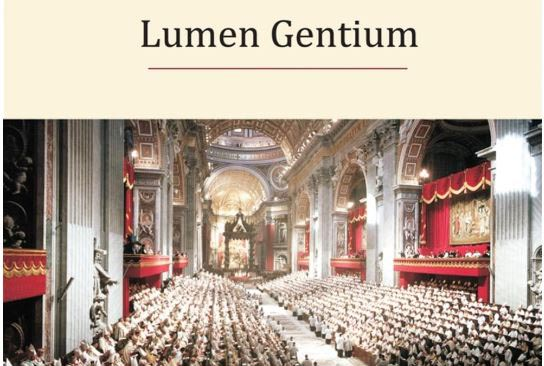
The New Ecclesiology of Lumen Gentium

There is no escaping several novelties in Lumen gentium (LG), among which are the church as 'sacrament' (yes, we know the Latin is = to 'mystery'); the introduction of the concept of the unity of mankind (not specified as in Adam, a unity of mere nature); the Church as "the Church of Christ which subsists in the Catholic Church"; the unbalanced and overly optimistic view of the non-Christian religions; the amorphous title "People of God" which many have conflated with all mankind per LG 1,1); and lastly, the Council's ethic of not condemning any errors at all, providing no canons or anathemas, which leaves all these ambiguities open to various interpretations.

We cannot minimize the figure of Fr. Karl Rahner, S.J. in the drafting of this document, either. Knowing that he was an evolutionist, and an existentialist, and a proponent of the "anonymous Christian" theory, we must look for the Rahnerian signature if not always in the texts, then in the possible ways of exegeting it. For Rahner, the distinction between nature and the supernatural is muted if not dissolved. He also sees a radical unity between matter and spirit a la Teilhard de Chardin. This leads to his heterodox theory of the supernatural existential - that all men have divinity at their radical center. Seeing Rahner's theology and thoroughly novel metaphysics signature helps us to understand why LG has destroyed so much of orthodox ecclesiology today.

Finally, taking the above into consideration, we must see how Pope John Paul II interpreted Vatican II in his encyclical Redemptor hominis which claims,
"Entrusting myself fully to the Spirit of truth, therefore, I am entering into the rich inheritance of the recent pontificates. This inheritance has struck deep roots in the awareness of the Church in an utterly new way, quite unknown previously, thanks to the Second Vatican Council..."
This new way is contingent upon his doctrine that "by His incarnation Christ has united Himself to each man" (GS #22) - "united to each man forever, and each man is a sharer in the mystery of the redemption (RH)." John Paul II obviously sees in the Council a permission to boldly thrust forward Rahner's (and DeLubac's) theory of each man having the divine life of supernatural grace within. In light of this doctrine, LG is quite easy to exploit as a vehicle for teaching a conflation between the Church and all humanity. And this very thing the neoModernists do, some more covertly than others, but always advocating Teilhard's Cosmic Christ and the advance of a [fictitious] evolutionary march that is growing in consciousness among all men of every religion.

Let us not pretend that there is not a dire need for true dogmatic testing in an era where the Nouvelle Theologie provides a different hermeneutic and alien canons for those that would see the Church corrupted as St. Pius X describes in Pascendi gregis.

Saturday, January 2, 2016

Theology is and always shall be Queen of Sciences

1. Theology is the science of the study of God. It had always been the "Queen of Sciences" until the Copernican Revolution juxtaposed theology against natural science by introducing a new cosmological model that opposed divine revelation. This cleavage has never been repaired, and the pro-Modernist partisans in the church are constantly seeking to exploit this cleavage against dogma, morality and Tradition.
The Evolutionism condemned in Pascendi gregis by St. Pius X destroys all religion because it denies that God can be the direct object of scientific study. It relegates God to a knowledge attainable only by internal experiences, and these driven by necessity (vital immanentism). Therefore, as St. Pius X teaches in Pascendi, the Modernist keeps the two spheres of theology and natural sciences separated in order to exploit a new metaphysic (the philosophy of Becoming in the place of the Scholastic philosophy of Being).
2. Modernism is the confluence, compendium, and rendezvous of all the heresies because it accomplishes what each of them on their own never could: the dissolution of the God revealed by Jesus Christ from the human mind. Modernism posits science as the judge of the sources of revelation, and as such, purges them of all supernatural content. Modernism assumes that profane science with all its changing and wrongly deduced theories and hypotheses is the canon or standard to use in measuring the truths revealed by God to man.
What then?
True science is judged by revelation, not the other way around. True science in St. Thomas Aquinas begins with God and ends with God. The essences and accidents of nature and nature's laws are subject to their Creator. This is not the case today, and if you imagine St. Thomas would be a scientist today like the great names of astronomy, biology, paleontology, cosmology, physics, etc.. then you would be wrong. St. Thomas would never imagine to separate natural sciences from theological science which is the judge and distiller of all natural truths and facts. The Catholic Church in our time has drifted far, far into the Modernist outlook that places science above theology (see: John Paul II's remarks to the Pontifical Academy of Sciences, 1992). This is a form of idolatry. We will never arrive at a true understanding of nature, science, metaphysics and sound philosophy by separating the Queen of sciences from her subjects or worse yet, subjecting revealed Truths to mere profane scientific theories.

Saturday, November 7, 2015

A New Theology, Another Christ?

 As the march of Modernist Evolutionism continues "forward," the explicitness of Teilhardian metaphysics and theology emerges with increasing boldness. John XXIII spoke of it in his opening address to Vatican II; Paul VI approved of it in Gaudium et Spes; John Paul II audaciously announced that evolution was "more than a hypothesis;" Benedict XVI hailed the resurrection of Christ as a "mutation;" and now Francis outdoes them all and refers explicitly to Teilhard de Chardin in a magisterial document:
"83. ...all creatures are moving forward with us and through us towards a common point of arrival, which is God, in that transcendent fullness where the risen Christ embraces and illumines all things. Human beings, endowed with intelligence and love, and drawn by the fullness of Christ, are called to lead all creatures back to their Creator.
243. At the end [i.e., at the Final Judgment], we will find ourselves face to face with the infinite beauty of God (cf. 1 Cor 13:12), and be able to read with admiration and happiness the mystery of the universe, which with us will share in unending plenitude. Even now we are journeying towards the sabbath of eternity, the new Jerusalem, towards our common home in heaven. Jesus says: “I make all things new” (Rev 21:5). Eternal life will be a shared experience of awe, in which each creature [Spanish: cada criatura], resplendently transfigured, will take its rightful place and have something to give those poor men and women who will have been liberated once and for all.
244. In the meantime, we come together to take charge of this [common] home which has been entrusted to us, knowing that all the good which exists here will be taken up into the heavenly feast. In union with all creatures [Spanish: con todas las criaturas], we journey through this [earthly] land seeking God…. Let us sing as we go. May our struggles and our concern for this planet never take away the joy of our hope." (Laudato Si)
If anyone doubts that this is the Nouvelle Theologie condemned by Pius XII in Humani Generis, please post your objections here. This is another theology which, in the final analysis, offers the world "another Christ" (2 Cor. 11:4) whom we have not received, and in whom faith is futile. Teilhard's Christic or Cosmic Christ is not the Christ of Catholic Faith.
"However, this Agnosticism is only the negative part of the system of the Modernist: the positive side of it consists in what they call vital immanence. This is how they advance from one to the other. Religion, whether natural or supernatural, must, like every other fact, admit of some explanation. But when Natural theology has been destroyed, the road to revelation closed through the rejection of the arguments of credibility, and all external revelation absolutely denied, it is clear that this explanation will be sought in vain outside man himself. It must, therefore, be looked for in man; and since religion is a form of life, the explanation must certainly be found in the life of man. Hence the principle of religious immanence is formulated."
Pope St. Pius X, ON THE DOCTRINES OF THE MODERNISTS
Pope John Paul II taught that Christ has united Himself with each man forever, and that each man is a "sharer in Jesus Christ, the mystery in which each one of the four thousand million human beings living on our planet has become a sharer from the moment he is conceived beneath the heart of his mother (RH #13)." The union he speaks of has nothing to do with Gospel preaching, contrition, repentance, faith, or baptism. This is Teilhard's Cosmic Christ.
"Christ the Lord indicated this way especially, when, as the Council teaches, "by his Incarnation, he, the Son of God, in a certain way united himself with each man". The Church therefore sees its fundamental task in enabling that union to be brought about and renewed continually. The Church wishes to serve this single end: that each person may be able to find Christ, in order that Christ may walk with each person the path of life, with the power of the truth about man and the world that is contained in the mystery of the Incarnation and the Redemption and with the power of the love that is radiated by that truth. Against a background of the ever increasing historical processes, which seem at the present time to have results especially within the spheres of various systems, ideological concepts of the world and regimes, Jesus Christ becomes, in a way, newly present, in spite of all his apparent absences, in spite of all the limitations of the presence and of the institutional activity of the Church." (emphasis mine)
Pope John Paul II, Redemptor hominis
And where will each person find Christ? In himself!
"...that we may be like those "violent people of God" that we have so often seen in the history of the Church and still see today, and that we may consciously join in the great mission of revealing Christ to the world, helping each person to find himself in Christ, and helping the contemporary generations of our brothers and sisters, the peoples, nations, States, mankind, developing countries and countries of opulence-in short, helping everyone to get to know "the unsearchable riches of Christ", since these riches are for every individual and are everybody's property." (emphasis mine)
Pope John Paul II, Redemptor hominis
In a devastating analysis, Father Johannes Dormann draws a startling conclusion about the theology of Karol Wojtyla:
"A comparison of the principles of knowledge in Cardinal Wojtyla's [Pope John Paul II] New Theology with those of classical theology makes the fundamental differences clearly come to light. In classical theology, God is the material and formal object of theology. In the New Theology of Cardinal Wojtyla, the object is man. The diametrical opposition is manifest. Through the confusion of nature and grace in the axiom of universal salvation, the traditional "dualism" is entirely eliminated. The traditional distinctions of the natural and supernatural knowledge of God, of natural and supernatural revelation, of natural reason and supernatural faith, of natural and supernatural theology, no longer apply. The virtue of faith, which is constitutive for the process of justification, is no longer required for salvation since all men are are a priori redeemed and justified.
...The Cardinal's New Theology provides an extensive foundation for interreligious dialogue: the "Church of the living God" (p. 17) unites all men. Universal salvation is the common basis. The concepts of revelation and faith are not proper to the Catholic religion. All religions contain genuine revelation. The faith encompasses all "believers" in all religions. Genuine faith is faith in humanity. But "revelation," which is offered to man in Christ," thus the Christian faith is for Cardinal Wojtyla the faith in which the "mystery of man," "existence in Christ," is "enlightened" once and for all. This "offer" is thus by no means necessary for salvation, nor is it exclusive or binding. There is also revelation, faith and the experience of God in other religions. On the basis of religious liberty, interreligious dialogue as a brotherly exchange of religious experiences for the sake of mutual enrichment is the primrose path towards universal religious harmony."
Father Johannes Dormann, Sacred Theology Doctor
Director, of the Institute for Missionwork and the Study of Religions at Wilhelms-University, Munster, Westphalen, Germany.
Quote taken from Pope John Paul II's Theological Journey to the Prayer Meeting of Religions in Assisi, Part 1, pages 121-123, (c) 1994 by Angelus Press

The most troubling doctrinal assertion of Redemptor hominis is the emphasis on the Incarnation at the expense of the Passion and priestly sacrifice of Christ on the cross. In the encyclical, the Pope uses the word 'redemption' 37 times; the word 'justification' is never used. Men are not redeemed by the Incarnation, although this is the unmistakable theme of RH. They are redeemed by the priestly sacrifice of Christ on the cross. Yet Pope John Paul II finds the basis for a formal union of each man with the divine person of Christ simply by the fact that Christ became man and men exist "in Christ". The encyclical claims this union without faith, baptism, or even the willingness of each man. Therefore the priestly sacrifice of Christ is reduced to a "sign of God's love" for man, instead of the means whereby men are redeemed and by which men can be saved by grace through faith.

This error is also metaphysical in that the break with classical soteriology is no doubt based on Wojtyla's evolutionism. For the Pope, the Incarnation is a peak of evolutionary development, about which some theologians (not Wojtyla) conjectured that spirit evolves from matter (Teilhard, Rahner). Therefore, Christ's Incarnation effects an actual change in human nature which now "exists in Christ" (Dormann).

The total break with the soteriology of the preconciliar era is clear. And there is no new penetration of theological insights at work here, but an attempt to synthesize modern scientific theories and hypotheses with the Deposit of Faith.
"God spoke of old to our fathers by the prophets; but in these last days he has spoken to us...by the Son, his Word, who became man and was born of the Virgin Mary. This act of redemption marked the high point of the history of man within God's loving plan. God entered the history of humanity and, as a man, became an actor in that history..."
Clearly here he calls the incarnation the efficient cause of the redemption. If men are redeemed by the Incarnation, and formally united to Christ forever, and "exist in Christ," then what remains? For them to arrive at this awareness of being united to Christ forever in their consciousness. Hence, the requirement for dialogue with men of all religions, who too, are united to Christ albeit in ignorance.

St. Pius X, in Pascendi:
 "Hence, Venerable Brethren, springs that ridiculous proposition of the Modernists, that every religion, according to the different aspect under which it is viewed, must be considered as both natural and supernatural. Hence it is that they make consciousness and revelation synonymous. Hence the law, according to which religious consciousness is given as the universal rule, to be put on an equal footing with revelation, and to which all must submit, even the supreme authority of the Church, whether in its teaching capacity, or in that of legislator in the province of sacred liturgy or discipline."
Pope St. Pius X, ON THE DOCTRINES OF THE MODERNISTS
Pope Francis is not introducing new ideas; far from it. He is building on the New Theology suppressed by Pope Pius XII with remarkable patience and consistency. The universalism increasingly explicit in Pope Bergoglio's doctrine is fully developed by John Paul II. Its primary metaphysic is evolutionary; its philosophy is existentialist; its theology is nondogmatic; its Christ is the Evolver, the Christic of Teilhard de Chardin. It is difficult not to conclude that this is indeed another Christ "whom we have not received" (2 Corinthians 11:4).
"Entrusting myself fully to the Spirit of truth, therefore, I am entering into the rich inheritance of the recent pontificates. This inheritance has struck deep roots in the awareness of the Church in an utterly new way, quite unknown previously, thanks to the Second Vatican Council..." Pope John Paul II, Redemptor hominis

Monday, June 29, 2015

Happiness over Tradition?

I am posting this here because it instructive of our current situation. So-called "progressives" are the evolutionists among us, who hold that anything old (tradition) is bad, and that everything new (latest manifestation of natural selection or Hegel's synthesis) is good, and must be preferred over the 'old.' Here, Coca Cola is juxtaposing tradition and happiness, to say that it is better to be perverted and happy (something yet to be proven possible) than to keep traditional morality. Coke dares to feature the loser in this ad's false dichotomy as the prize - the little child, the ultimate target of indoctrination in the new hedonism.
This is what we are up against, and if you consider yourself an evolutionist, you are part of the problem. This is why Evolutionism is condemned so forcefully by St. Pius X in Pascendi Gregis: it swallows all of reality and introduces the evolution of dogma, here prefigured by the suggestion of the evolution of morals by Coca Cola. So tradition is the enemy for our progressive friends, because it stands in the way of "happiness" for the new Epicureans, and anyone who defends it is defending what 'nature' has already rejected in its perpetual dialectic.
We feel this acutely in the Church where Tradition is openly despised in favor the "New Pentecost" of Vatican II and the Novus Ordo Missae preferred to the old stodgy missal of St. Pius V. Perhaps this is why Pope Francis can now openly refer to the false prophet of Evolution Teilhard de Chardin in his encyclical Laudato Si: he wants us to be happy.

Monday, June 22, 2015


Rambling Thoughts on the Role of Philosophy Since Vatican II and its Impact on Religion
 
    For most Catholics, the theology and message of Pope John Paul II is shrouded in a sort of cloudy, opaque ambiguity. Even theologians struggle to extract a plain, clear meaning from his encyclicals and locutions. This itself can be a cause for concern. The duty of a bishop is to present the Gospel to the faithful in clear, firm and unambiguous terms, passing on faithfully what he has received.

    Existentialist philosophy cannot be an ally in the discharge of that duty. The calculus of the partisans of the Nouvelle Theologie was that 'modern man' could not accept the Gospel as presented in Thomistic terms (Scholastic philosophy of St. Thomas Aquinas) because they are too 'fixed, firm, and static '. Therefore, the Gospel needed to be communicated to 'modern man' with malleable, dynamic terminology that 'modern man' would deem acceptable. Vatican II teaches this openly:

"Thus, the human race has passed from a rather static concept of reality to a more dynamic, evolutionary one. In consequence there has arisen a new series of problems, a series as numerous as can be, calling for efforts of analysis and synthesis." 
(Gaudium et Spes  #5)

    Now, the New Theology claims that it has not changed the contents of the Deposit of Faith at all. It has merely changed the way dogmas are explained philosophically. Existentialism is a philosophy that sees that the only reliable 'truth' is that we exist and that this existence (based on experience) is absurd, bereft of meaning unless man gives meaning to it. To go further, personalism holds that existence is only understood from the perspective of personhood - what the New Theologians called an anthropocentric (man-centered) philosophy. Personalism holds that man must determine what is real or true by his own subjective judgment or experience.  The Second Vatican Council invokes a personalistic idea known as the mystery of man, a phrase to be found nowhere in tradition as tradition is firmly theocentric (God-centered). Therefore, existentialist philosophy plus personalism equals the imprecise, ambiguous "pastoral language" of the council and the conciliar Popes.

    Because existential personalism holds that man can only know truth by his experience, it requires that this truth does not come to man from outside himself, viz, by external revelation, but from within. This error is known as immanentism. Immanentism teaches that there is nothing that is in man that does not come from man. Of course, this error rejects the possibility of objective truth and external revelation. It argues that all men have the truth within, and the truth within resonates with others through 'consciousness.' This is condemned in the strongest, clearest terms by Pope St. Pius X in his 1907 encyclical Pascendi gregis. In layman's terms, it means that truth goes from the heart to the head, while tradition teaches that truth goes from the head to the heart. When properly understood, these two opinions are seen as polar opposites, completely at variance with one another. Immanentism is a key component of Modernism, the synthesis of all heresies.

  Teilhard de Chardin taught that all the universe is evolving towards a mythical 'Omega Point' which he imagined as a sort of Cosmic Christ, where God and the creation become one. This is condemned in Pope Pius XII's encyclical Humani generis as pantheism (nature is God) and monism (God and His creatures are of the same substance). Teilhard was a hero to many because he seemed to 'rescue' Catholicism from its apparent inability to adapt to the new 'truth' of evolution. He syncretized Catholicism and evolutionism by subordinating the Deposit of Faith to a scientific theory. This is also condemned in Pascendi, and Teilhard's teacher, George Tyrell, S.J., was excommunicated by Pope St. Pius X for teaching it. Pius XII suppressed Teilhard by not permitting him to teach theology or philosophy nor to publish any of his speculations. As soon as Pius XII died, theologians that were suppressed under his Pontificate for their sympathy with Teilhard's views were not only rehabilitated, but some were appointed to the Second Vatican Council as periti, theological experts. Among these was Fr. Henri DeLubac, S.J., a vigorous defender of Teilhard. At the time of the council, Bishop Karol Wojtyla credited DeLubac with shaping a great deal of his theological outlook.
Fr. Teilhard de Chardin, S.J. subjugated the
Catholic Faith to the theory of evolution.

    Whether the Popes personally believed this way or not is a topic for another discussion. What is evident is that they believed it necessary to present the Gospel in ways that men who DO believe this way will find reasonable. Let me repeat that: What is evident is that they believed it necessary to present the Gospel in ways that men who DO believe this way will find reasonable.
This is why the strong, clear Thomistic language disappears from Papal encyclicals beginning with John XXIII. Modern man, who believes in an 'evolutionary explanation of reality' (GS 5) needs to hear the Gospel in a way he will find acceptable to his enlightened, modern, scientific way of reasoning. Hence, you have the council teaching this way:

"by his incarnation, Christ has in some fashion united himself to every man" (GS 22).

What does this mean?

Pope John Paul II teaches in Redemptor hominis,

"...by the Son, his Word, who became man and was born of the Virgin Mary. This act of redemption marked the high point of the history of man within God's loving plan. God entered the history of humanity and, as a man, became an actor in that history..."

    Clearly here he calls the incarnation the efficient cause of the redemption.

    It plainly points to the incarnation and not the passion as the source of being united with Christ. For it does not say that by his passion, death and resurrection, Christ has united himself with those who believe, repent and are baptized, but that by becoming man, Christ has "in some fashion" united himself with each man. This is existentialist - viz, Christ joined himself to his creation and therefore changed the existence of humanity itself, profoundly affecting each and every man to whom he is now "in some fashion" united.

    But what does this really mean? It appears to teach immanentism, that by his incarnation (again, not by the cross, but the birth of Christ), that the divinity is already joined to man by virtue of his existence. Man has divinity 'within', it only needs to be aroused by consciousness. His consciousness is awakened to his true dignity (the mystery of man) as already being united to Christ by the church's witness. The church witnesses to every man by dialogue, not preaching. Dialogue requires a universal ecumenism, which is modeled at the Assisi Prayer meetings. Hence, John Paul II could write in Redemptor hominis,

"Entrusting myself fully to the Spirit of truth, therefore, I am entering into the rich inheritance of the recent pontificates. This inheritance has struck deep roots in the awareness of the Church in an utterly new way, quite unknown previously, thanks to the Second Vatican Council..."

    The mystery of man idea was probably the conception of Fr. Henri DeLubac, S.J., who for his  book Surnaturel was forbidden to teach by the Holy Office under Pope Pius XII. The theory as proffered in GS and the encyclical Redemptor hominis (1979) advances thusly: Christ reveals the Father to man. In so doing, he reveals man to man himself. Man is called to divinity, and therefore is destined to it by his Creator. Therefore, man is already divinized, but does not realize it without Christ.

    The difficulty with this doctrine should be evident. What complicates its already questionable line of reasoning is the way the council conflates the church with humanity. It does this by a confusing reference to 'man' as opposed to men or more specifically, Christians when speaking abstractly. In other words, 'man is called to divinity.' This is then applied in a more concrete way as to appear to teach that all men are saved. The council and the conciliar Popes (especially John Paul II) utilize this abstract, philosophical way of reasoning to great effect. Repeated so often it then appears to be a Catholic dogma that the 'People of God' encompasses the entire human race. Lumen gentium advances this idea when it refers to the church as the "sacrament of salvation to the whole human race." What is a sacrament? A sacrament is a tangible, physical sign of a spiritual operation performed by Christ. So, the church is mediating this sacramental action for the whole human race. LG is not clear as to whether this is potential or actual. I believe that these ambiguities were intentionally calculated to make both an orthodox or a Modernist interpretation possible.

    This idea is famously explained by Fr. Karl Rahner's doctrine of 'anonymous Christians.' Rahner taught that by the mystery of man, many were really Christians but did not know it because they were born in non-Christian societies or lacked opportunity to hear the Gospel. This is extending the theory of Baptism of Desire to extravagant lengths. Is this what Pope John Paul II refers to three times in RH as "the truth about man"?  It completely agrees with the Modernist idea that all men have divinity within them, and that it merely needs to be stirred or awakened in their consciousness. One can easily see how the preaching of the cross (most specifically in the Mass of St. Pius V) would be an obstacle to dialogue and ecumenism so necessary to awakening consciousness in men who are already united to Christ but do not realize it. Therefore a new liturgy was necessary to mitigate the preaching of the cross and to focus on ecumenical themes.

    And that is the source of my problems with Vatican II and in particular, the teaching of Pope John Paul II. St. Paul teaches that the Word of the cross is the power of God unto salvation (1 Cor. 1:18). Men are saved by hearing the preaching of the cross. It comes to them from without. It is external to the hearer. St. Paul teaches that for this reason, preachers are sent (Romans 10). For what cause? To preach Jesus Christ, and him crucified (1 Cor. 2:2). Rather than awaken something already within men, God gives supernatural grace to the one that believes the message of the cross and enlivens a soul that was previously dead in trespasses and sins (Eph. 2:1).

    The council seems to want to avoid the offense of the cross. This may be argued from Pope John's opening address which eschews condemnations and rebuking of errors for 'the medicine of mercy.' Modern man is offended by the message of Christ crucified for sins. This is known in theology as the scandal of the cross. As St. Paul teaches,

"For Christ sent me not to baptize, but to preach the gospel: not in wisdom of speech, lest the cross of Christ should be made void.  For the word of the cross, to them indeed that perish, is foolishness; but to them that are saved, that is, to us, it is the power of God.  For it is written: I will destroy the wisdom of the wise, and the prudence of the prudent I will reject. Where is the wise? Where is the scribe? Where is the disputer of this world? Hath not God made foolish the wisdom of this world? For seeing that in the wisdom of God the world, by wisdom, knew not God, it pleased God, by the foolishness of our preaching, to save them that believe.  For both the Jews require signs, and the Greeks seek after wisdom:  But we preach Christ crucified, unto the Jews indeed a stumblingblock, and unto the Gentiles foolishness:  But unto them that are called, both Jews and Greeks, Christ the power of God, and the wisdom of God. For the foolishness of God is wiser than men; and the weakness of God is stronger than men." 
(1 Cor 1:17-25)

    John Paul II saw in framing the doctrines of church in Modern philosophical terms a deeper penetration of the mystery of Christ:

"...The opening made by the Second Vatican Council has enabled the Church and all Christians to reach a more complete awareness of the mystery of Christ, "the mystery hidden for ages" in God, to be revealed in time in the Man Jesus Christ, and to be revealed continually in every time." (RH)

    And how are we to understand this more complete awareness?

"...Accordingly, what is in question here is man in all his truth, in his full magnitude. We are not dealing with the "abstract" man, but the real, "concrete", "historical" man. We are dealing with "each" man, for each one is included in the mystery of the Redemption and with each one Christ has united himself for ever through this mystery.

...this is "each" man, "the most concrete" man, "the most real"; this is man in all the fullness of the mystery in which he has become a sharer in Jesus Christ, the mystery in which each one of the four thousand million human beings living on our planet has become a sharer from the moment he is conceived beneath the heart of his mother." (RH)

    What are we to make of this "utterly new way" of seeing the church, this "more complete awareness of the mystery of Christ"? Perhaps the Pope himself has provided us with the hermeneutical key:

"Assisi Prayer is a "visible illustration, an exegesis of the events, a catechesis, intelligible to all, of what is presupposed and signified by the commitment to ecumenism and to the interreligious dialogue which was recommended and provided by the Second Vatican Council."
(Christmas address of the Pope to the Cardinals and members of the Curia on 22 December, 1986, L'Osservatore Romano, 5 January 1987, page 7)

"Look at Assisi in the light of the Council!"
(Papal address in the General Audience of 22 October, 1986)